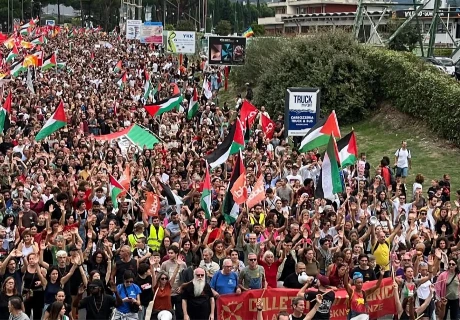
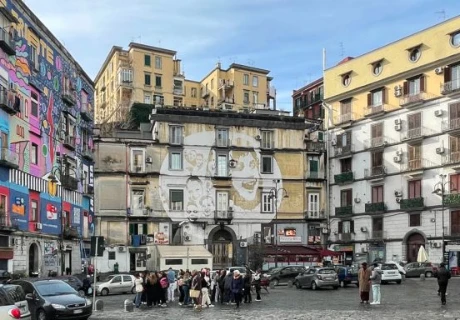
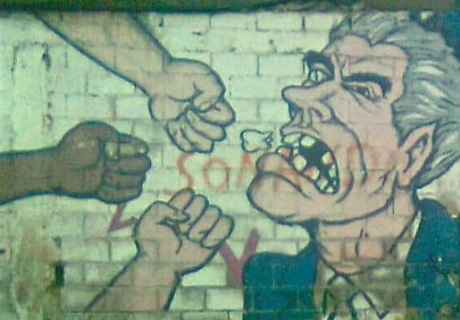
Gaza is a capitalist knot. In the struggles against the Israeli genocide, the interconnectedness of all dimensions of anti-capitalist struggles is reflected.
Drugarska Komisija decided that the Award for Social-Critical Engagement “Ivan Radenković” for the year 2025, for the first time since 2021, not be awarded to an individual recipient or a separate group, but rather to all organized anti-colonial struggles against the genocide in Palestine. The award is a political act, and in this way it aims at directing attention to the historical and political specificity of the Palestinian situation, the current (but also continuous) tragedy of the Palestinian people in Gaza, as well as to the significance of Palestine for universal questions of inequality, injustice, and unfreedom.
Why is Gaza important to us?
Gaza is a capitalist knot. In the struggles against the Israeli genocide, the interconnectedness of all dimensions of anti-capitalist struggles is reflected. Viewed historically, the colonization of Palestine shows us that there is no capitalism without racism and imperialism, without the drawing of borders for national and ethnic constructs, without ecological catastrophes, without the prison industry and the military machinery of death, without exploitations in all shades, without the seizure of land from enslaved peoples, as well as without policies that treat certain populations as an absolute surplus. Here all capitalist relations are congealed.
In 2 years, the industry of death has produced around 100,000 dead—killed and systematically starved—of whom the majority are children and women, then around 2,000 doctors and health workers, as well as around 3,000 of those who tried to reach aid and food. Because of the genocide, around 90% of the population has also been displaced. Entire settlements and cities have been leveled to the ground, and numerous bodies are still beneath the ruins and their exact number is not known. More than one hundred hospitals and clinics have been destroyed; around 90% of the medical infrastructure, as well as that for water supply, has been destroyed or damaged; and the ecological catastrophe created through the use of weapons and all-encompassing destruction is rising to its maximum. Silence before such a massacre of a people is one form of complicity. Besides the direct support of the USA, of almost all European governments, but also of numerous Middle Eastern states, there are manifold forms of indirect support, which have sustained the genocide and continue to sustain it.
We are also witnesses to intensified repression against pro-Palestinian activists across the so-called democratic world. Detentions, arrests, police beatings, dismissals from work or threats of losing one’s job, deportations, media censorship, manipulations, and absurd accusations of antisemitism have already become an expected reaction of the state apparatus. Gaza has in fact revealed the repressive essence of liberal democracy. Neither right-wing nor liberal governments prevented the genocide in Gaza; on the contrary, in many ways they enabled it and fueled it, and – for who knows which time – showed that for them human lives are only indicators, less important than the fattening of their profits and servile alignment with imperialist positionings. For these reasons, the Award that goes to the organized anti-colonial struggles against the genocide in Palestine is conceived as support and encouragement to all those who rise against injustice, state and capitalist violence, and who demand freedom for the Palestinian people, as well as freedom from imperialism in general.
The millions of people who in the last two years have gone out into the streets, those who despite police brutality protested en masse and resisted the complicity of their governments—through student blockades and uprisings in student campuses, workers’ strikes, sabotage of weapons deliveries, all forms of revolt against governments that export weapons, as well as organized flotillas—all of them represent the expression of one and unique struggle that endures and grows. History shows us that progressive struggles were never led through the figure of individuals, heroes and heroines, as perfidious capitalist individualism presents it to us, but always collectively and in an organized way. The struggle for Palestine that is organized and anti-capitalist is not a humanitarian, moralistic-civil action. The moral consciousness of the concerned citizen, although it might have all the reasons on its side and a right to indignation, is an ambivalent form of expressing protest that negates the principle of collective organization and cooperation. An exclusively moral and humanitarianist consternation before Zionist crimes—and only psychopaths are not horror-struck at that—nevertheless remains a comfortable position, because it undertakes nothing to politicize and organize more seriously that matter. Only the organized resistance of the Palestinian people, as well as international commitment to that struggle, can bring hope.
This year’s award is also a call to stop the delivery of weapons to Israel as well as the other forms of direct or indirect complicity in the genocide. Boycott implies the refusal of any participation in activities that support Israeli-Zionist policies and contribute to the maintenance of a capitalist genocidal economy. As has been shown by the founding of BDS (Boycott, Divestment, Sanctions), in the colonization of Palestinian territories and the denial of the rights of Palestinian peoples, the academy also has an important role, that is, universities and other institutions that produce knowledge and cultural content. They either participate directly in Israeli colonial policies—through flows of financing, armament, the reproduction of Zionist ideology, and the hiring and hosting of Zionist ideologues—or indirectly, through manipulation, silence, covering up, or erasing the history of the Palestinian Nakba, which has lasted for decades. Institutions and the individuals within them, by taking a stance and condemning these crimes, can do a great deal to break through the ideological framework that seeks to present the Palestinian tragedy as a natural catastrophe.
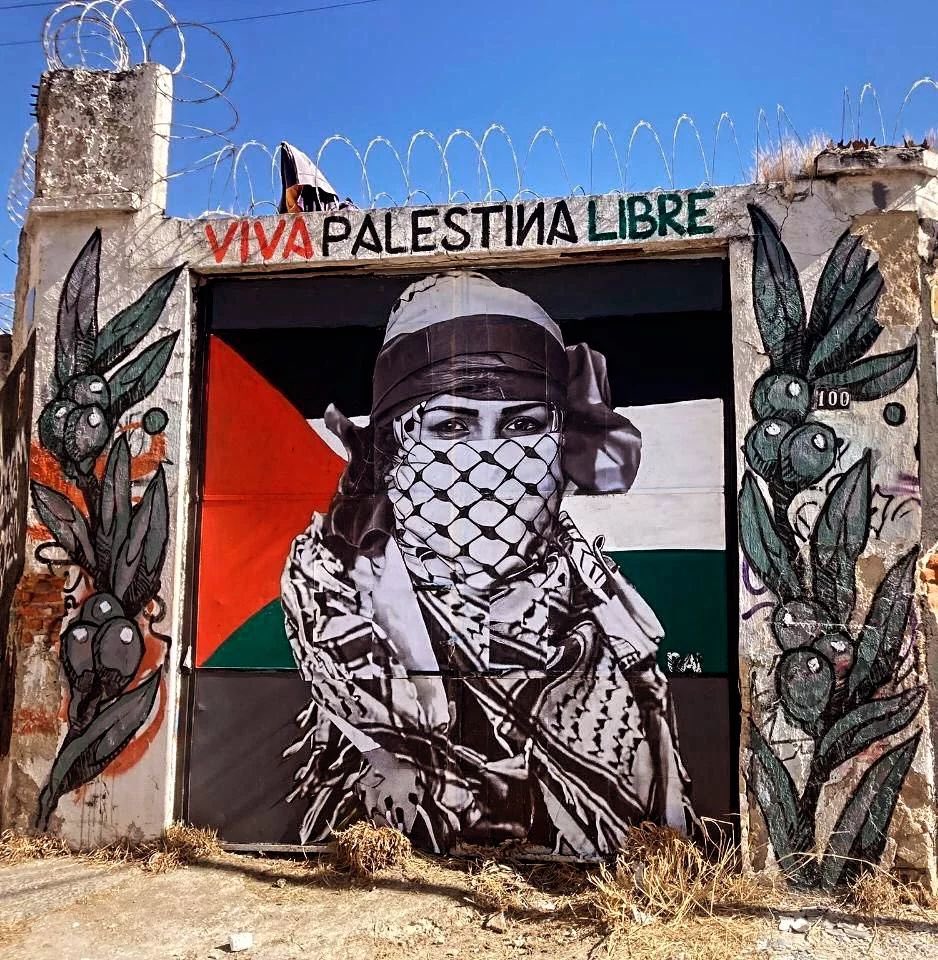
This year’s award is especially addressed to all those forms of Palestinian resistance and struggle in Serbia and the other former Yugoslav countries that are not expressed as moral, individualistic protest, mere identity-based identification, or a nationalist reflex, but rather emerge from more radical positions. The history of the peoples in our region is rich in anti-colonial, anti-imperialist, and anti-fascist struggles, and testifies to many affinities and connections with the Palestinian situation. It is enough to recall the example of the socialist republic of Yugoslavia, which, after the Six-Day War in 1967, broke diplomatic relations with Israel, giving strong political support to Palestine (the PLO established its first representation in Europe in Belgrade in 1971), ultimately recognizing Palestine as a state, as well as offering other forms of humanitarian and social assistance to Palestinians (including scholarships for students). In that sense, the Palestinian symbols, scarves, and flags that appeared at student protests in Serbia during the last year were encouraging, as a sign that there is hope that the history of international solidarity continues.
The Ivan Radenković Award for Social-Critical Engagement was established above all as a politics of memory for a friend and comrade, and also as a political award, in symbolic form, recognizing initiatives, works, and undertakings in all the fields in which Ivan was active: theory, philosophy, music, translation, politics, and activism. Therefore, this award is not an award in the customary sense: it brings no material gain, no ‘prestige’; it marks no one as ‘excellent’ and supports no one’s career. By naming the recipients of the award, we are, in fact, inscribing Ivan’s life into certain continuities. We read particular struggles and engagements as shared and progressive—as fields into which what Ivan did is also inscribed. This is an award through which we remember Ivan, listen to and share his music, and continue to read his analyses, critiques, and translations. Bearing in mind Ivan’s theoretical and political work on questions of the economy of imperialism and unequal exchange (he wrote on Arrighi and Amin), his tireless critiques of European Union policies, as well as his interest in internationalist solidarity, the award dedicated to Gaza and to Palestinian and pro-Palestinian resistance inscribes yet another important theme into the continuities of our interrupted lives.
.jpg)